Millstone
The Eight Mountains: A NovelThe Millstone is a heavy, wheel-shaped stone that joins Bruno and Pietro’s childhood play to a later act of youthful celebration. First encountered in the decaying interior of an old mill, it is at once a material obstacle and the center of an extravagant plan: Bruno proposes rolling it into the river to make fish leap out. Much later, the stone reappears in the water, and Bruno discloses that he moved it himself with a car jack on his eighteenth birthday. Its return makes an abandoned object carry a story across time.
Discovery in the Ruined Mill
Pietro and Bruno find the stone in a solitary building rising above a riverbank, among nettles, brambles, wasps’ nests, and other signs of neglect. Bruno climbs through a first-floor window and descends into the lower room; Pietro follows, scraping his arms on the sill. The building’s ruin is not merely a backdrop: the boys enter it by clambering through an opening, and the stone waits below amid the remains of a discarded interior.
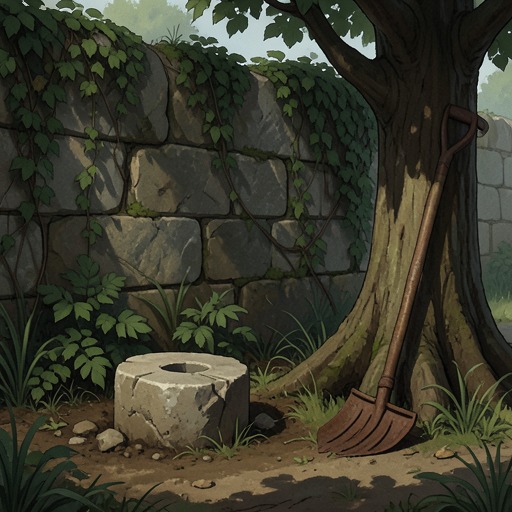
The lower space is divided by low walls into four equal rooms resembling tanks. In the dimness, Pietro makes out cans, bottles, old newspapers, torn shirts, four wrecked shoes, and rusty equipment. Beside this scattered debris, Bruno bends over a large, white, polished stone shaped like a wheel. Pietro asks what it is, and Bruno identifies it as “The grindstone,” then clarifies, “The stone of the mill.” The naming converts an unfamiliar form into an object with a former use, though the passage gives no account of the mill’s working life.
Pietro knows what a grindstone is but has never seen one in person. He reaches out and finds it cold and slimy; moss has collected in its central hole and clings to his fingertips like green mud. That close inspection makes the stone more than a piece of old machinery or a shape to admire. Its weight and surface are encountered directly, against the sting of the scratches Pietro has just received while following Bruno inside.
Bruno’s Plan for the Stone
Bruno’s response to the millstone is to imagine setting it upright, pushing it outside, and rolling it down into the river. In his account, the stone’s plunge will make the fish leap from the water so the boys can eat them. The plan connects the abandoned object to the river and to food, but it is also a test of what the two boys might accomplish together.
Pietro considers the proposal both wonderful and impossible. The millstone seems too heavy for them, yet the imagined spectacle is so appealing that he does not object. The scene holds those two judgments together: the stone’s mass makes the plan impracticable, while the pleasure of picturing the feat makes it compelling. Their play begins not with proof that they can move the stone, but with the shared imaginative possibility of doing so.
The boys also find evidence that someone has already tried to shift it. Two woodcutter’s wedges have been driven beneath the stone, raising it just enough from the floor. Bruno takes a stout stick, apparently the handle of a pickaxe or spade, and hammers it farther into the gap with a stone, then works the handle underneath and braces it with his foot. The wedged stone and improvised lever give his idea a practical foothold, even as the size of the task remains daunting. The millstone’s weight shapes the action: it cannot simply be picked up, so the boys turn to leverage and prepare to work together.
The Stone in the River
Years later, after a conversation recalls the flood of 2000 in Grana, Pietro sees a large white, wheel-shaped stone in the water near the mill. The river still carries visible traces of the flood: tree trunks, beams, pieces of cement, and other wreckage have been dragged down from the mountain, while erosion has exposed roots along the bends. Against that damaged landscape, the familiar shape of the stone raises Pietro’s spirits. He asks whether the water brought it down too.
Bruno corrects the assumption: he had thrown it down before the flood. When Pietro asks when, Bruno says, “I did it to celebrate my eighteenth birthday.” Asked how he managed it, he answers, “With a car jack.” The brief exchange revises the earlier scene. What had been introduced as a childhood fantasy of rolling the stone into the river became, in Bruno’s later account, an actual deed accomplished years afterward by a different means.
Pietro smiles and imagines Bruno entering the mill with the jack, bringing the millstone out through the door, and setting it rolling downhill. He says he would have loved to be there. When he asks whether it was good, Bruno answers, “It was amazing.” The recollection gives the stone a history beyond its abandoned place in the mill: it became the instrument of a birthday celebration, and its later presence in the river makes that private episode visible to Pietro.
A Material Link Across Time
The Millstone recurs in two distinct moments: first as an object the boys inspect and imagine moving, then as an object Bruno says he actually sent down the slope. That return joins the boys’ early capacity for shared invention to a later, independent act by Bruno. The means change from the childhood plan’s improvised wedges and lever to the car jack he names in retrospect; the river remains the destination associated with the stone’s descent.
The object also brings material fact into contact with memory. Its cold, mossy surface and formidable weight belong to Pietro’s immediate encounter, while its movement through the mill doorway and down the slope exists in the later scene as his imagined reconstruction. Bruno’s concise explanation supplies the action and its occasion, but Pietro’s wish to have witnessed it registers the distance between the event and the person remembering it with him. The stone, still recognizable near the mill after the flood, gives that recollection a concrete point of return: what was once a plan in a ruined building is remembered through the object that reached the river.